Notes from a DIY writing residency
Fruits of the 1p saving challenge
I started this year by taking myself off on a DIY writing residency for three weeks.
I was at a project in Catalunya called La Bassa Mar, a self-organised space for trans and nonbinary people that hosts group retreats. I asked if I could come solo for a few weeks to write, and they responded warmly. I was welcome.
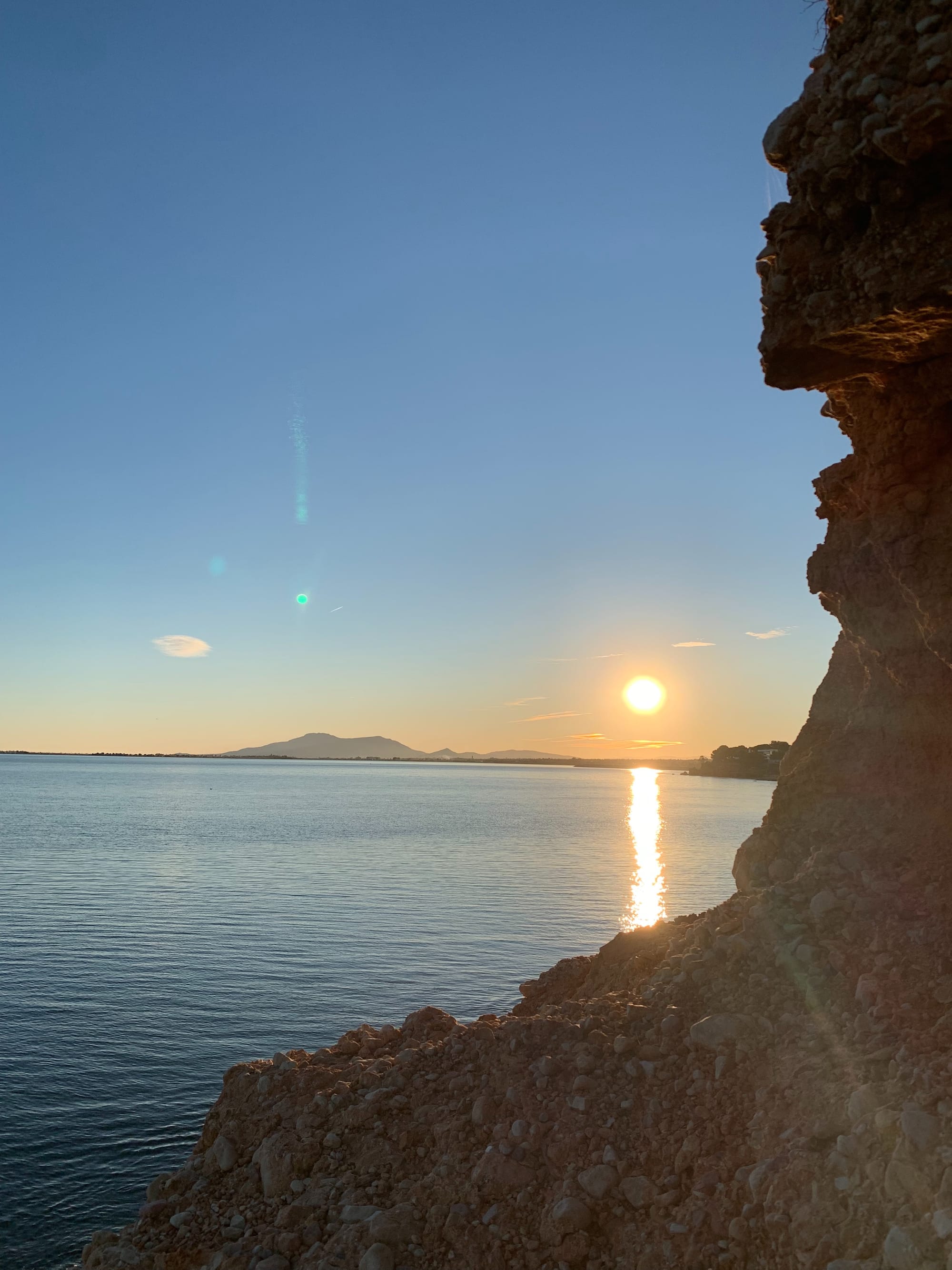
When I arrived in the early evening, the olive trees on the land were silver in the dusk. I like arriving at night. It offers time to land a little and absorb the smells and sounds of a new place, before seeing the whole picture. The next morning, I watched the sun rise and saw that I was on gently rolling, rocky red land covered in groves of olives, between mountains and sea.
I made a daily rhythm around the sun. I woke in the dark, ate breakfast watching the sun come up over the olive trees, and was at my desk in the quiet first light of the day. After I finished writing I went for a run or did some yoga, then walked down to the beach to spend time with the sea, arriving home in the sunset. Bed early and sleep long. This is a good routine for me, and I wish I could bring it home to London. I set some intentions for my writing residency, too: read, rest, write.
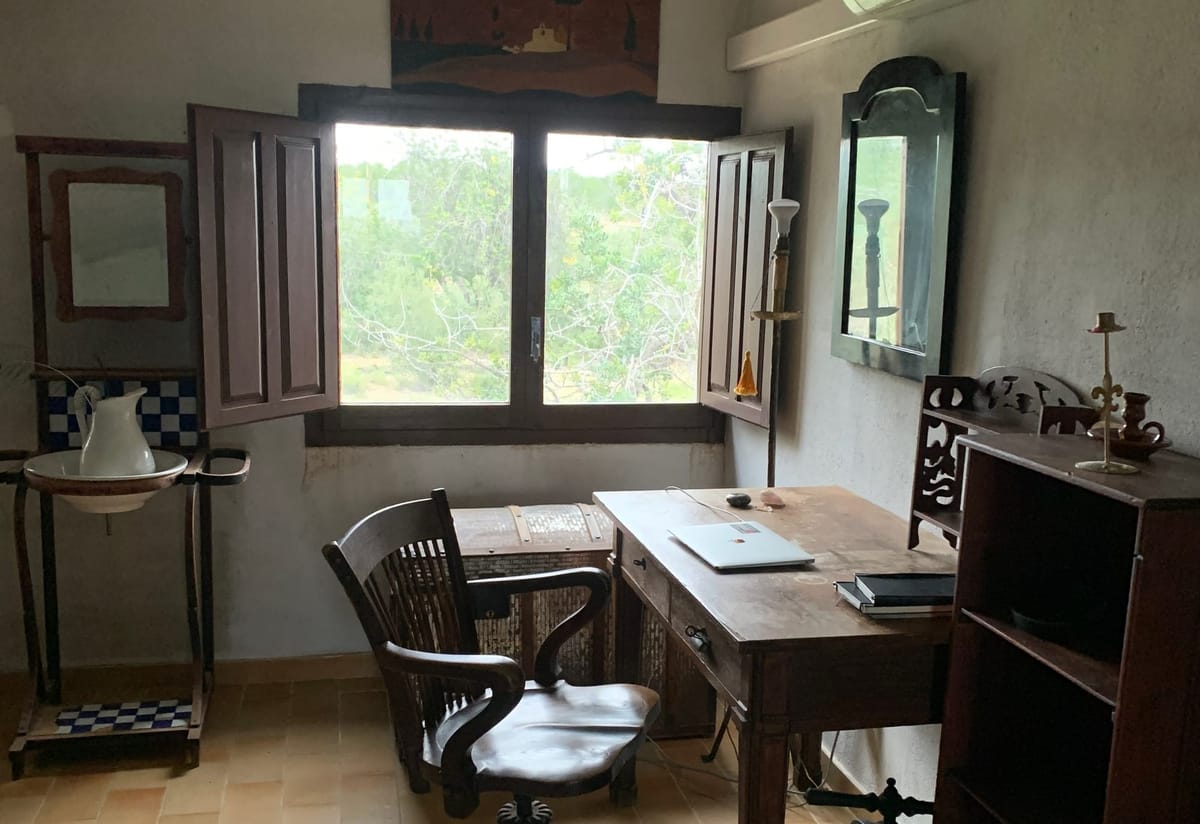
I started the residency working at a big wooden desk in a quiet corner of the house. Green trees and mountains out of the window to my left, and to my right, shining sea on the horizon. I was disciplined, keeping my phone on airplane mode until I’d finished writing for the day. My focus was absolute. Sleeping ten or 11 hours a night. Seeing the sea every day. Regularly watching the sun rise and set. I wrote thousands and thousands of words that week, and found an extreme pleasure in working in this way. I felt extremely fortunate.
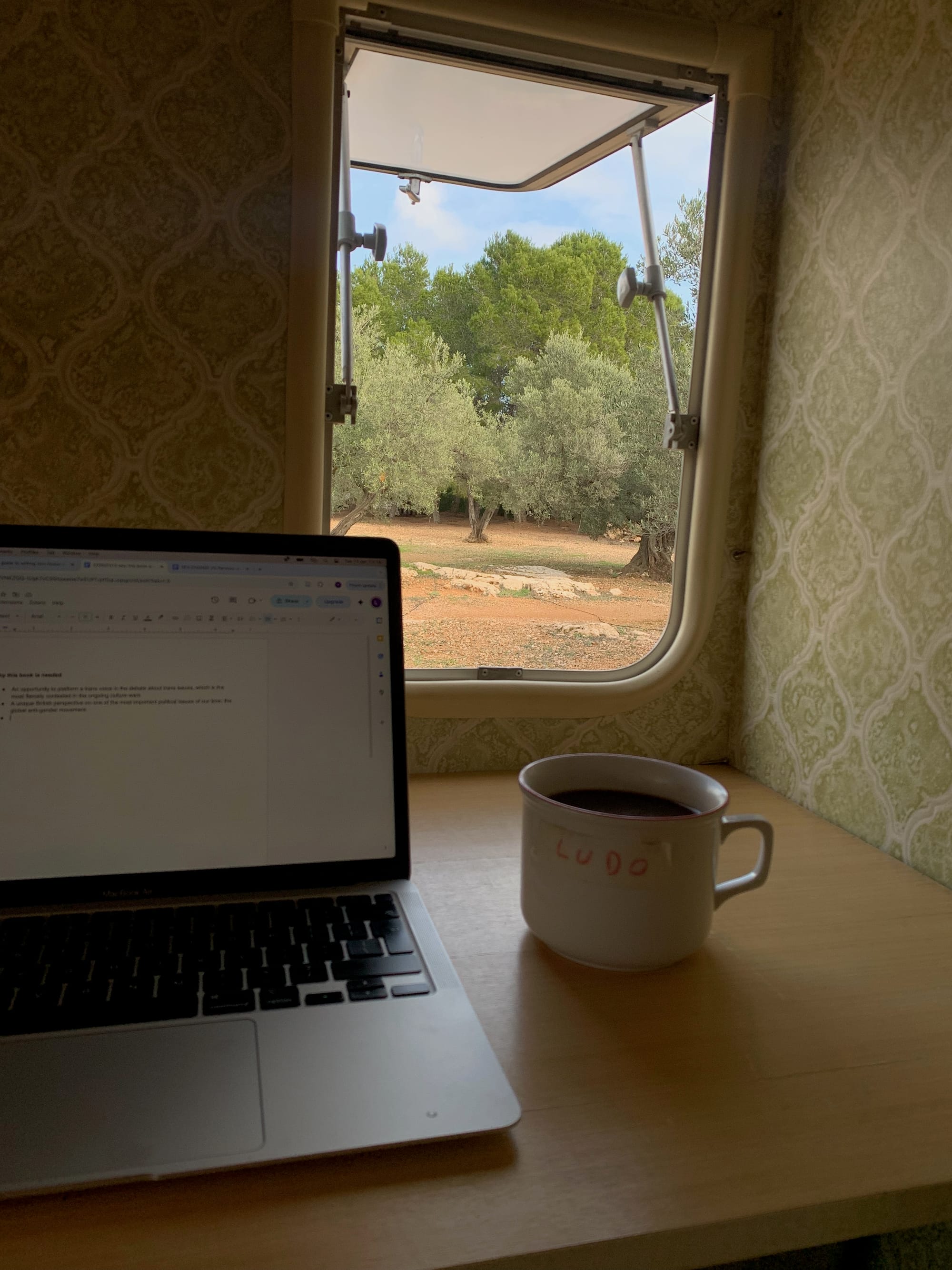
The second week I worked from a caravan, secluded in the olive trees – a gorgeous place to write, but here I had to hotspot internet from my phone and I quickly succumbed to the dopamine hit of notifications and social media. I moved inside the house to another beautiful desk – small and marble-topped. The writing in the second week was patchy, and I told myself that this stemmed from moving locations, being less settled.
In the third week, back upstairs at my original desk, my concentration was still intermittent. The clarity of the first week did not return. I would be leaving with what I had set out to get done and felt happy with the work, but I’d been gloomy and grumpy, sleeping badly. Homesick.
Before I went to Catalunya, one week – which seems fairly standard for organised writing residencies – seemed far too short an amount of time to land in a new place and get any writing done. But now, I can see that one week is actually a really good length for an intense burst of writing. By the third week, I was under-stimulated: my brain whirring away, but without any relief from the work. I hadn't had any deep conversations, spent time with friends, seen new horizons or blown off steam; I'd stayed in one place and rhythm for too long.
No regrets, though: if I’d only had a week, I’d have wished I was staying longer. How long I can intensely focus on writing without distraction was a lesson that I could only learn by doing. I’m also glad that I self-organised this writing residency, rather than going to a commercial one, for many reasons including flexibility, autonomy, and that it meant the majority of my savings from the 1p saving challenge – which is how I paid for the trip – went to a trans+ retreat project that supports activists to rest and connect.
And as for those intentions I set: I wrote thousands and thousands of words, wrote off 2025’s sleep debt, rested and relaxed, and read nine books. People often ask me for book recommendations and reviews of what I've been reading – if that's you, then here you go.
Books I read on my DIY writing residency
Empire of Pain: The Secret History of the Sackler Dynasty by Patrick Radden Keefe (2021)
I’d been reading this giant book about OxyContin, Purdue Pharma and the US opioid epidemic since November, and I finally had time to finish it here. Keefe’s an investigative journalist whose longform writing for the New Yorker I’ve always enjoyed; this was the first book of his I’ve read. Incredibly comprehensive and detailed, it covered more than 100 years of Sackler family history and unpacks the aggressive, deceptive marketing strategies and pursuit of profit above all else that caused the US opioid epidemic. The amount of money the Sacklers made is dizzying. A gripping read with complex storylines, albeit sometimes slightly dense amounts of information.
Stag Dance by Torrey Peters (2025)
As a treat for finishing Empire of Pain I then read the latest novel from Torrey Peters. It’s a collection of three stories and one novel, defying genre; I didn’t realise she’d already published two of the stories and I’d already read them, which sadly shortened the time I spent blissed out reading. As I’d expected, this was a page turner, a total delight. I enjoy that Peters doesn’t water down her approach to queerness and transsexuality for a mainstream audience, and the titular Stag Dance in particular was very funny and engaging.
She Said: Breaking the Sexual Harassment Story That Helped Ignite a Movement by Jodi Kantor and Megan Twohey (2019)
This is the backstage story of how the authors, both New York Times journalists, exposed Harvey Weinstein’s history of assault and sexual misconduct and catalysed #MeToo. Possibly because I’m also a journalist I love books like this, with all the juicy details and emotional tension from the reporting process. I raced through this and thoroughly enjoyed it. Sadly I did look both of them up afterwards and found, perhaps unsurprisingly, that Twohey was the co-author of that horrible 2022 New York Times hit piece on trans youth and puberty blockers.
Vulture Capitalism: How to Survive in an Age of Corporate Greed by Grace Blakeley (2024)
I didn’t finish this because it was too dry for me, and what I did read can be summed up by the subtitle it was originally published with: Corporate Crimes, Backdoor Bailouts, and the Death of Freedom. I chose this as part of an ongoing effort to read more about economics and capitalism but honestly I find reading about them both so boring (Yanis Varoufakis’s writing is my exception to this rule). I’m glad people like Blakely understand it, her revelations and analysis are important and insightful and we need left-wing economics books like this to be out there, but I need more storytelling.
Coolie Woman: The Odyssey of Indenture by Gaiutra Bahadur (2013)
Happily the next book I read was full of beautiful storytelling. Bahadur traces her family history from where she grew up in the US to Guiana, where she was born, back through generations of Indian workers to her great grandmother, who arrived as an indentured worker, or coolie woman, from India. I knew little about indenture in this period of British colonialism so learned a lot, and Bahadur is a generous writer, giving both a comprehensive historical account with archival research and interviews and her own thoughts and feelings about what she was unearthing. Highly recommend it, it’s quite long but worth it.
Shah of Shahs by Ryszard Kapuscinski (1982)
Although I was trying not to read the news while I was at La Bassa, the public uprising and regime crackdown in Iran was ongoing and when this book came up in my search for nonfiction written by journalists it seemed an apt time to read it. This is Kapuscinski’s analysis of the events that led to the Iranian revolution of 1978-79 and the ousting of Mohammad Reza Pahlavi, the last Shah of Iran. I found Kapuscinski’s tendency to generalise quite annoying, his portrayals of the country heavily orientalist, and he lacked sources in the student movement and on the left. But the book was readable and short, and Kapuscinski’s detailed visual account of Tehran post-revolution and reporting around Savak, the secret police, were very good.
Them: Adventures with Extremists by Jon Ronson (2001)
Back to books by investigative journalists. This was a humorous and engaging true story about getting to the bottom of a conspiracy theory strangely shared by a radical Islamic activist in London, a Ku Klux Klan leader, Ian Paisley, Alex Jones, and members of a Christian cult in the Swiss Alps. I hadn’t read Ronson before, though we used to talk on Twitter. His narrative is crisp and pacing superb, defusing heavy and disturbing material with humour, and using dialogue to show absurdity without sermonising about it. A lesson in how to do more storytelling in fewer words.
Caste: The Origins of Our Discontents by Isabel Wilkerson (2020)
I read the first few chapters of this and was totally absorbed by Wilkerson’s thesis, which is that caste is the underlying, encoded structure in the US that racism is an expression of. Looking to caste systems in Nazi Germany and India to understand anti-Black racism in the US, she uses historical analysis and contemporary stories to make her case. I was glad to be reading this but have stopped, for now; I was struggling to get to sleep, and I think reading harrowing personal accounts of racism before bed might have been why.
Model Home by Rivers Solomon (2024)
So instead I read a horror novel by one of my favourite writers – a joy because I didn’t know there was a book of theirs I hadn’t read. I love it. Madness and ghosts and a sick house and death. Their writing is powerfully clear and engrossing. I’d really recommend this and Solomon’s other books, especially their first two novels, An Unkindness of Ghosts and The Deep.