Wet hunks
Grief, marshes and Storm Henk
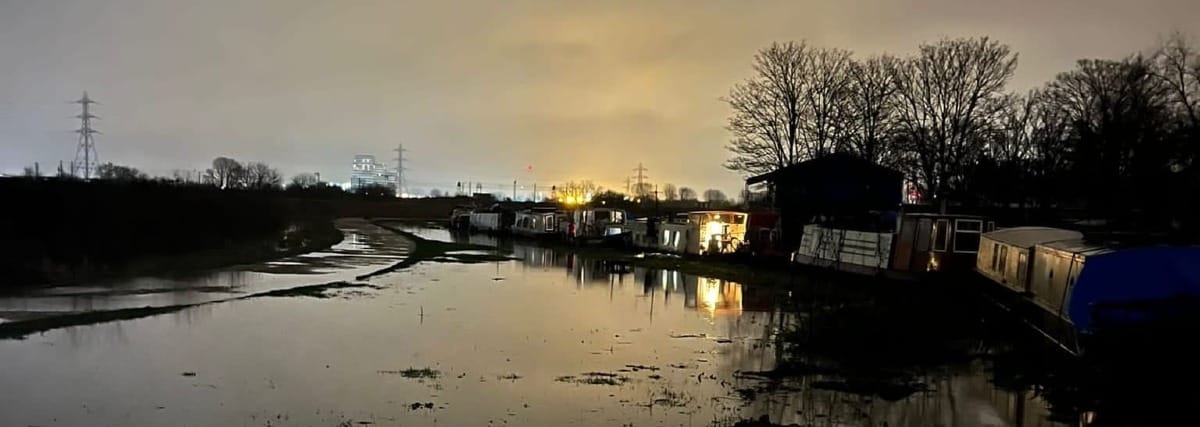
For the first few days of 2024, it rained steadily. Walthamstow marshes, already waterlogged, became a string of small p that swelled together into a great sheet of water. I moved my boat to the marshes on January 4th, one month after Groucho, the cat I lived with, had gone missing. The move said what I was struggling to voice: that I no longer believed he was going to come home. I had been waiting for him in the spot where he'd left me; going out most days to call for him. I had held firmly to hope through winter's darkness, but it was time to move on, to catch up with the rest of my friends, moored on the marshes.
The physical act of moving the boat felt heavy, like when there are weeds caught in the propellor dragging behind and slowing the boat down. I did a small ritual when I arrived on the marshes, to mark the move and think of Grouch.
It was still raining and the river was rising. I went outside to check the slack in my ropes, which tied my boat at either end to mooring pins I’d hammered into the soft ground with a mallet. The water levels had risen so much that my neighbour’s ropes were too tight, pulling his boat to slanting. We loosened them together, and then I checked on a friend’s barge, moored just behind mine. The rising water levels had pulled her ropes too tight as well and the barge was tipping, but the rain and the tightness of the wet ropes made them hard to loosen. I was clambering in the falling light on a wet slippery boat, in the rain, as friends in other boats also came outside to sort their ropes out and check on the rest of the boats around us.
The first danger, when the river rises, is that the ropes slowly pull a boat down and towards the land, so the boat tilts to one side. Water comes in through the skin fittings – holes in the boat’s sides, where pipes empty waste water – on the side leaning down towards the river, and the weight of this water in the boat tilts it further, drawing more water in: the boat begins sinking. On the cold dark wet marshes, the river was still rising, and a small group of us were soon outside working to loosen ropes and save the boats.
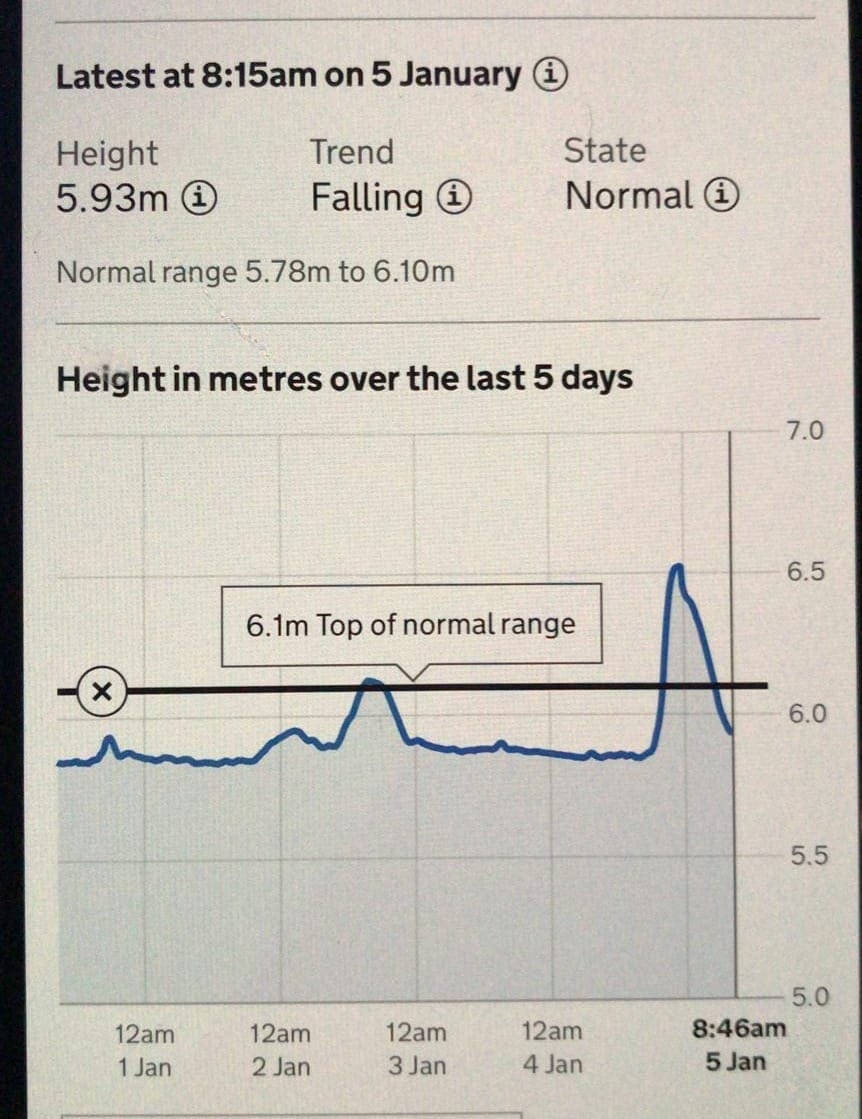
The next danger to the boats came fast. The river rose higher than the bank and spilled out onto the marshes, water pouring across already flooded ground. Now, the risk was that boats would float over the edge of the bank onto the land, and when the water level fell those boats would be stuck – grounded on the marshes or, more likely, caught on the bank and tilting into the river, at risk of filling with water and sinking.
To keep a narrowboat from floating onto land you need a few pairs of strong arms to push it back, and then long objects – we had life rings and logs and tires, but what we really needed were metal scaffolding poles – to drive into the riverbed between the boat and the bank, to hold the boat in the river, off the land.
A friend’s widebeam, too heavy to hold against the flow of the water, had floated over the edge onto land. It was hard to know, with the water over our knees, where the edge was, exactly. It took many of us a long time to work out how to keep the widebeam safe. There's a raised levée forming a gravel path along the border between the grassy riverbanks and the marshland proper, and water was now flowing from the river channel and going over the path, which had disappeared – but I could hear the river pouring over it down onto the marshes.
The fire brigade came. But they could not, apparently for health and safety reasons, go into the flood themselves. They stood on a bridge and, lighting our efforts with a huge floodlight, ordered us to get out of the water. The boats, we explained, are our homes, and might sink. We asked them to help us, but they would not enter the water. They grew frustrated that we would not leave the boats and soon the police were there too.
An absent friend’s boat was floating over land. Three of us pushed it back into the river, using planks of wood from another boater to secure the boat safely. I’d come to know this person a little through my month of searching for Groucho, which had involved a lot of knocking on other people’s boats, and now they took us inside their boat, into the warm. I was freezing. We started removing sodden layers in front of the fire but then a message came through: our friend further down the marshes needed help with her neighbour’s boat. We went back out into the cold.
I remember wading through water that was up to my mid thigh. The feeling of being in the centre of a disaster, with the waters swirling all around as far as I could see. That my boat neighbour had diving shoes made of neoprene, so much better for these conditions than my heavy boots full of water.
A moment of calm by the fire on my lover's boat, watching them eat an egg sandwich.
Arguing with the cops. Undoing other boater’s ropes, knots on knots on knots, cursing these strangers who didn’t tie one good knot and leave the rest of the rope easy to unwind, so their boat could be quickly freed in an emergency like this one.
We heard that the reason the flood was so bad, the water level the highest it had even been, was because the Canal and River Trust hadn’t opened the gates at the weir lower down the river, which would have let the water out into the flood relief channel. Apparently the CRT hadn’t fixed a broken gate and it was stuck shut.
The water levels plateaued a little after midnight, and then, as the river started to fall, a water rescue unit arrived. The men from the unit got into the water, and told the cops and firefighters to leave us alone and let us back to our boats. At some point, the river level went back below the banks, and my adrenaline levels also started to fall. I returned to my boat, stripped off soaking layers, and crawled into bed for a few hours sleep.
When I woke up and looked outside, it was daylight and the sky was clear. The floodwaters had receded, the river was back in its channel, and dogwalkers were crunching along the gravel path. The water from the night had soaked into the ground and both riverbanks and marshland were topped with grasses, not lakes. It was as if the flood had never happened.
On the news, there were reports of Storm Henk flooding small businesses in Hackney Wick, further down the river where the water had also gone over the bank and into the warehouses. A restaurant boat had sunk on the Thames. But there was nothing about the great flood we’d experienced on the marshes.
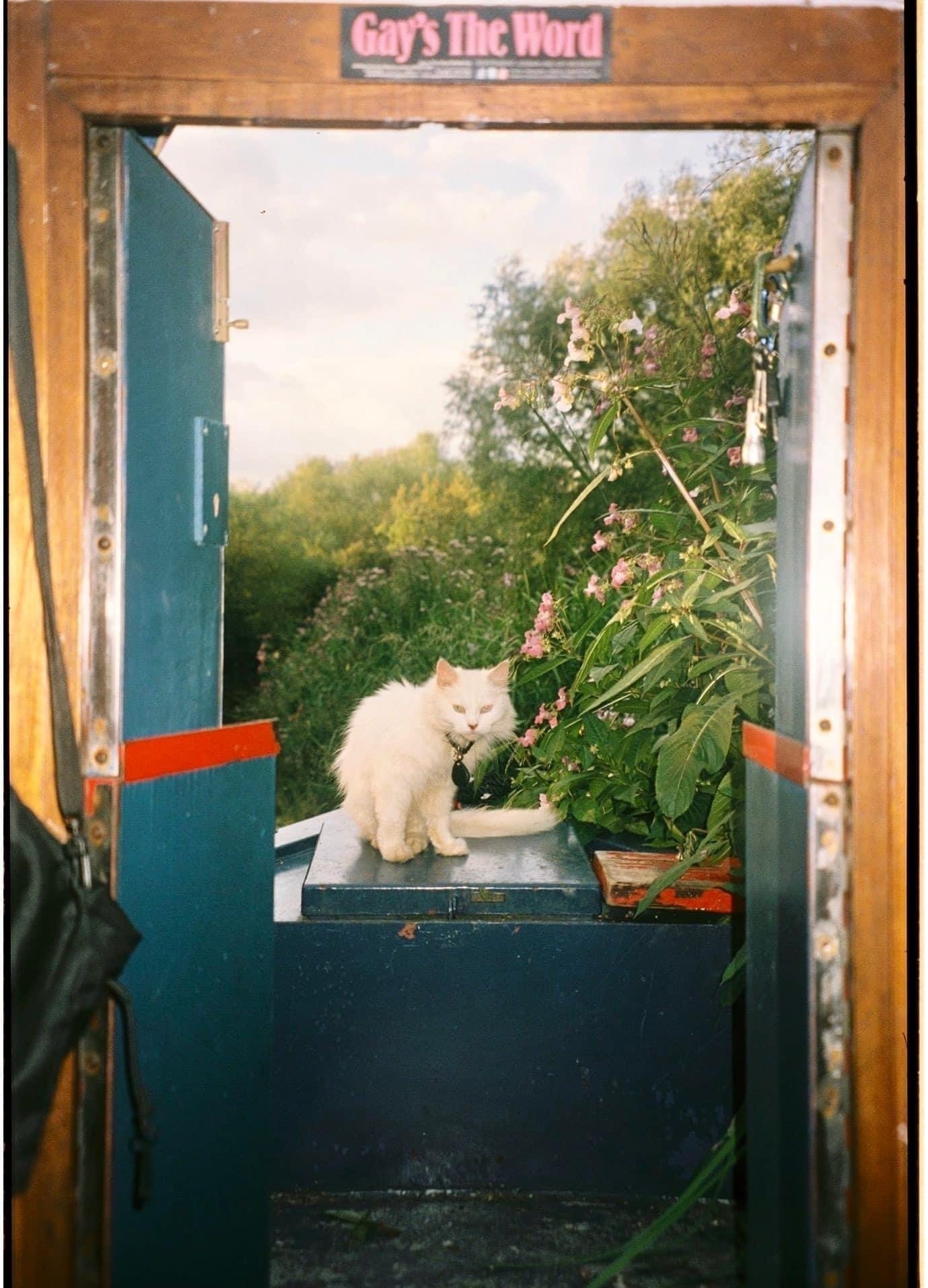
Sometime in the night, the body of a small animal had floated up in the river. A friend found it, and that day, as I pottered, oblivious, around my boat, another friend collected the body and took it to the vet, who scanned the microchip. My lover came round for a tea and gently delivered the news: it was Groucho.
He had been found between a boat and the bank, very close to where he’d gone missing – right at the centre of our huge search for him. It seemed he'd been right there in the river for that whole desperate month of looking and knocking and flyering and calling and hoping and grieving; my intuition that he wasn’t going to walk back through the door of our boat had been correct.
One evening a few days later, we gathered on one of the bigger boats to eat a takeaway, organised for us by friends who’d been away and whose boats we’d looked after in the flood. Not a single boat had sunk on the marshes. We realised that we’d learned a lot, and started planning some flood skill shares. We needed more kit: knives for cutting ropes, scaff poles to stop boats going onto land, neoprene shoes, waterproof overalls, whistles and headtorches. Of course, we also needed a name, and a logo to go on the back of our jackets. Someone came up with the Water Emergency Team, or W.E.T. The logo had a carabiner on it. Wet hunks, for Storm Henk. We sat together gently, tired and still dazed. I was thinking of Groucho, falling and sinking into the river nearby.
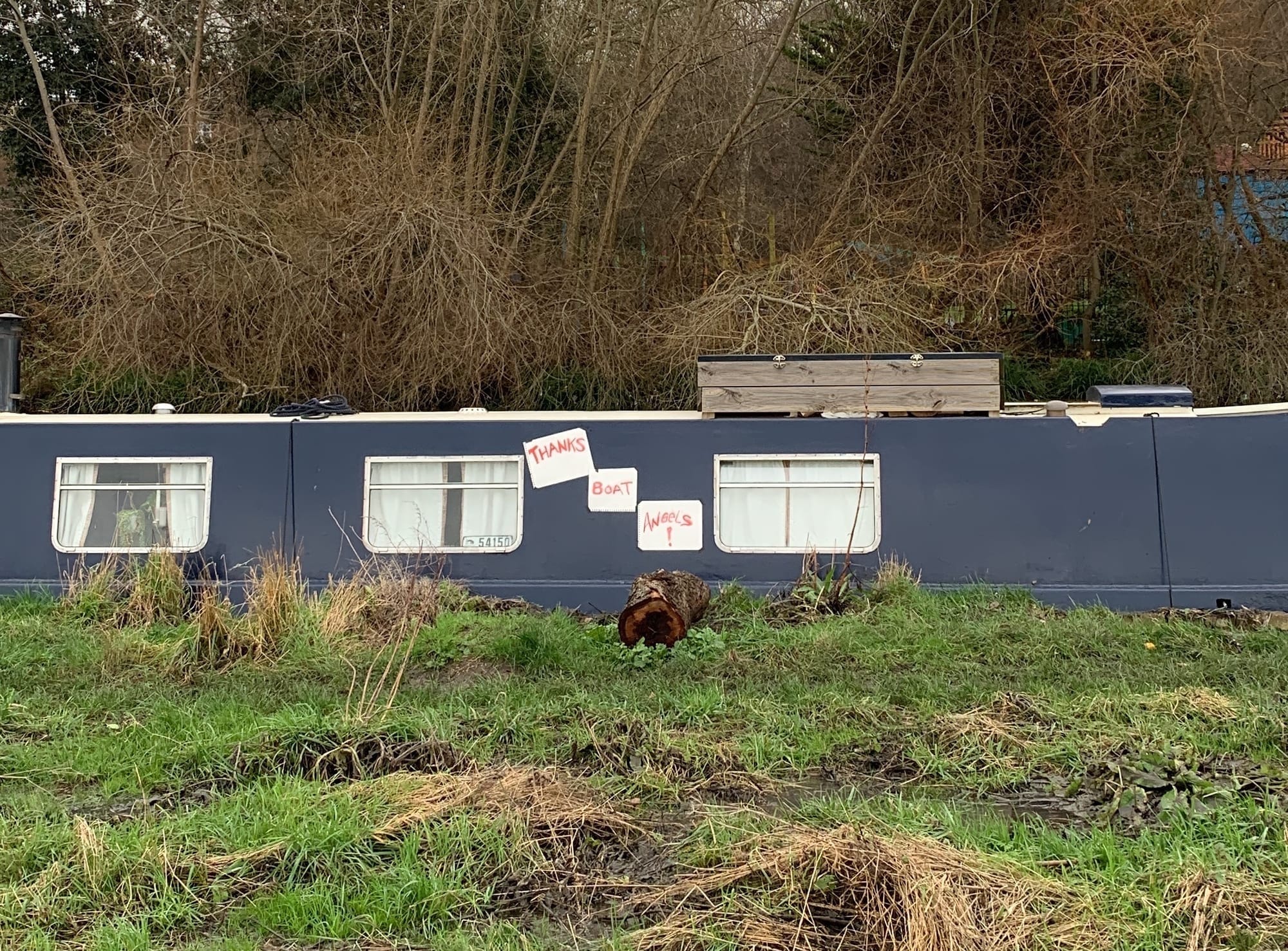
The next day, I walked out along the gravel path at the edge of the marshes, to cry in the fresh air. There was a handwritten sign stuck on one of the narrowboats we’d looked after in the flood. “Thanks boat angels,” the sign said.